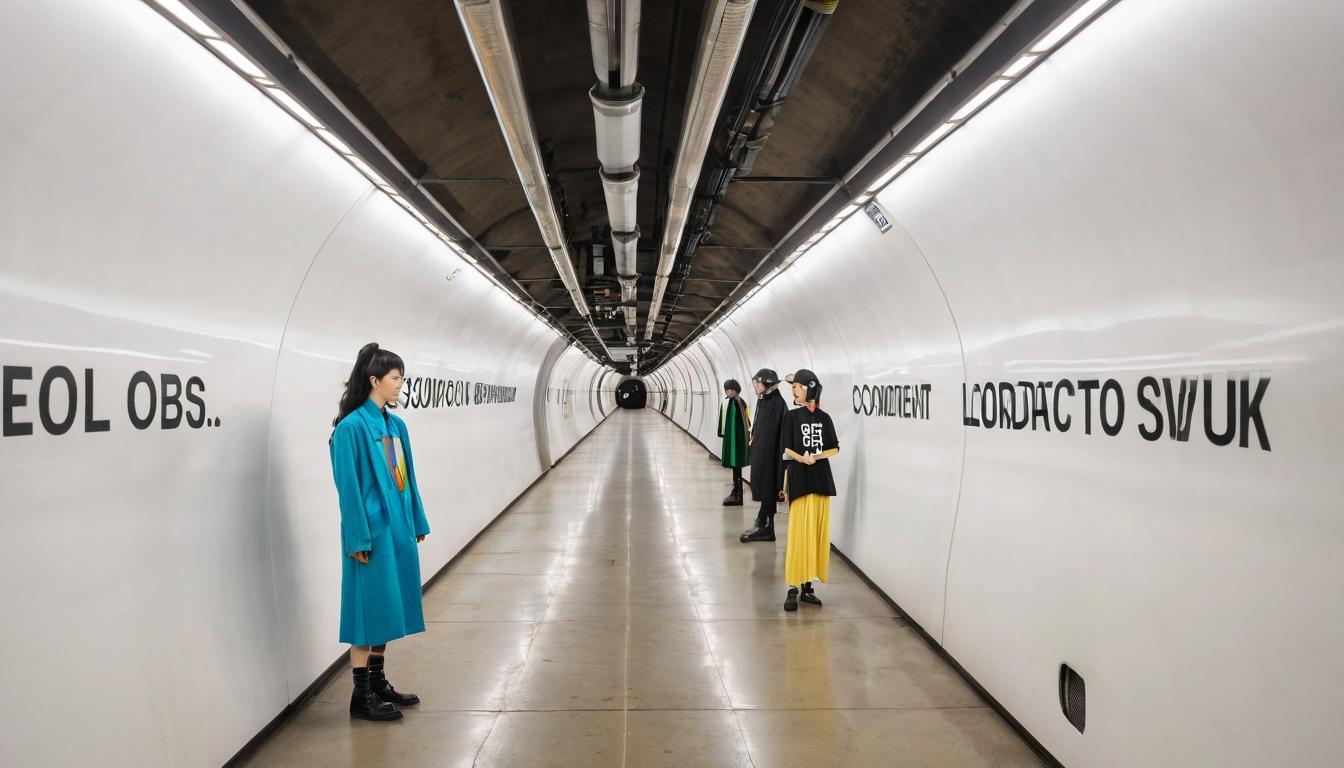
In the dimly lit backrooms of Seoul's Hongdae district, where the air smells of soldering irons and ambition, a collective called Noise Kitchen is quietly dismantling the boundaries between what we hear and what we wear. They're not designing clothes; they're translating soundwaves into textile patterns using hacked sewing machines that respond to audio frequencies. The resulting garments—rippled denim jackets that mirror bass drops, silk scarves printed with spectral analyses of underground techno—aren't just merchandise. They're wearable archives of moments that never made it to streaming platforms. This isn't fashion inspired by music. It's fashion as music's physical manifestation, a phenomenon bubbling up from cities where subcultures can't afford separate scenes.
Meanwhile, in London's Elephant and Castle, a former parking garage now houses the 'Tactile Frequency' lab, where designers and audio engineers collaborate on garments that literally interact with sound. A prototype jacket contains piezoelectric threads that vibrate subtly against the wearer's skin in response to specific musical frequencies—creating a private, physical layer to the listening experience. "We're tired of fashion just referencing album covers," says lead researcher Elara Vance, her hands stained with conductive ink. "When you can feel the bridge of your favorite song humming against your collarbone, that's intimacy. That's what both industries have been missing."
This convergence is being driven by necessity, not just aesthetics. As touring becomes economically precarious, musicians are turning to wearable technology as a new revenue stream and creative outlet. Hyperpop artist Kaito Mirai recently performed wearing a dress embedded with LED strips that pulsed in real-time to her vocal pitch, designed in collaboration with a Tokyo fashion collective that usually makes costumes for noise musicians. The dress later sold as a limited edition art piece for more than her streaming revenue from the entire year. "The garment became an instrument," she explains over crackling Zoom connection. "And suddenly, my body on stage wasn't just delivering sound—it was visualizing it."
Yet this fusion faces resistance from both established industries. Major fashion houses still treat musical collaborations as marketing opportunities—another celebrity wearing another dress to another awards show. The music industry, for its part, remains suspicious of anything that can't be monetized through traditional channels. "When we pitched 'sonic textiles' to investors, they asked about the playlist integration," laughs Noise Kitchen's founder, known only as Morse. "They couldn't grasp that the clothing IS the medium. You don't need headphones when your hoodie has a memory of last night's illegal rave woven into its very fibers."
The most compelling developments are happening completely offline, in defiance of digital surveillance and algorithmic categorization. In Mexico City, a group calling themselves 'Hilos Rebeldes' (Rebel Threads) creates custom jackets for local punk bands using fabric treated with a solution containing magnetic tape particles. When played through a modified cassette deck, the jackets emit faint, ghostly recordings of the protests where the garments were first worn. It's fashion as resistance archive, music as material memory—neither art form subordinate to the other, but fused into something entirely new.
What emerges from these underground experiments is a blueprint for cultural survival. In an age of disposable streaming and fast fashion, these creators are building artifacts that demand physical engagement. The 'album tee' is being reimagined as a tactile interface; the concert souvenir transformed into a sensory time capsule. As both industries grapple with sustainability crises and diminishing returns on digital content, this underground synthesis suggests an alternative path: objects that are loved because they're lived in, music that's experienced because it's embodied.
The revolution won't be televised, but it might be worn. From Berlin's abandoned power plants to Bangkok's midnight markets, a generation of creators is stitching together what commerce has kept apart. They're not waiting for brand partnerships or record deals. They're building the future in basements and back alleys, one vibrating thread at a time—and the resulting harmony is something you need to feel to believe.
The sonic seam: how music's underground is stitching fashion's next rebellion