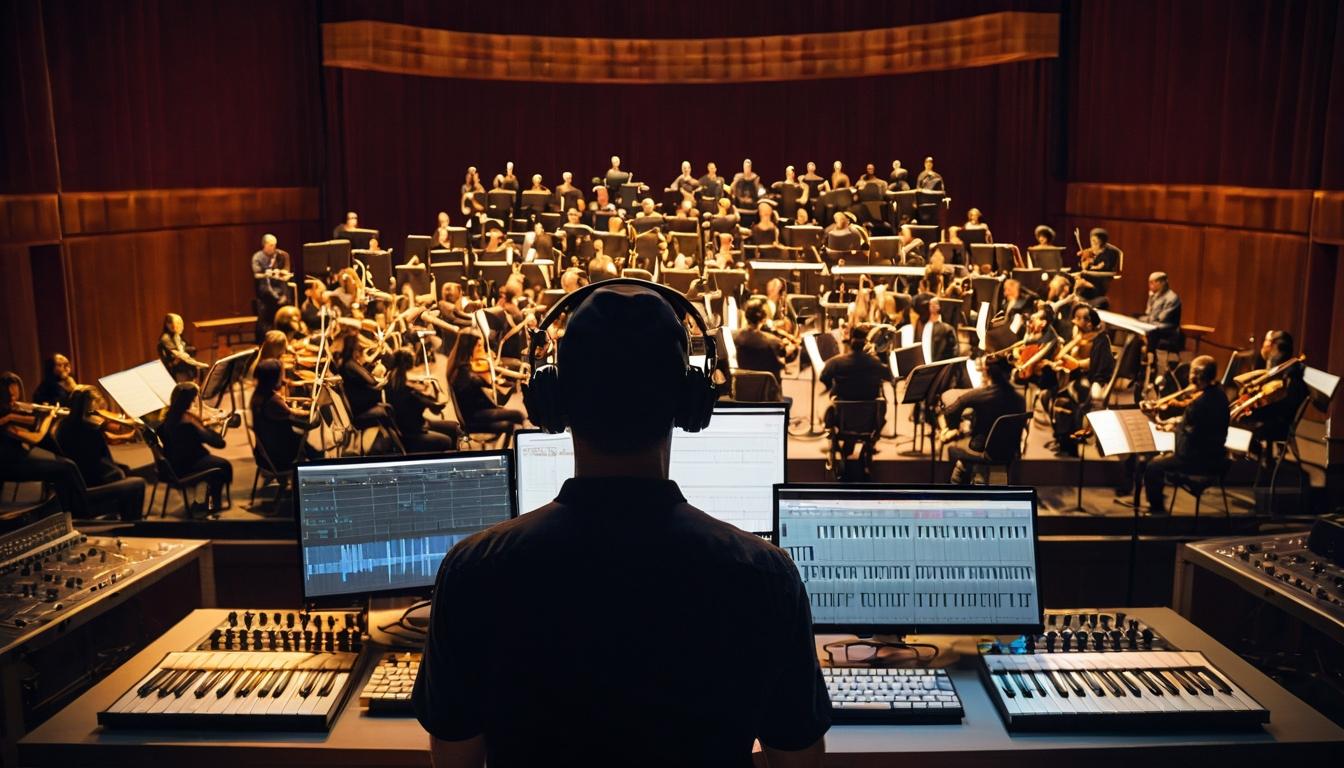
While most film music coverage obsesses over John Williams' latest Star Wars theme or Hans Zimmer's thunderous superhero scores, a quiet revolution has been unfolding in the shadows of Hollywood's soundstages. The real story isn't happening in the Dolby Atmos mixing suites of Marvel Studios, but in the converted garages and home studios where a new generation of composers are dismantling the very definition of what film music can be.
These aren't your grandfather's film composers—they're sonic architects building bridges between genres that have never spoken before. Take Mica Levi's work on 'Jackie,' which used microtonal string arrangements to create a psychological portrait of grief that felt more like a contemporary classical piece than traditional film scoring. Or the way Nicholas Britell incorporated hip-hop production techniques into 'Moonlight,' creating a score that breathed with the same rhythm as its Miami setting. These composers aren't just writing music to accompany images; they're creating parallel narratives that exist in the spaces between dialogue.
What's most fascinating about this shift isn't just the music itself, but how it's being created. The democratization of technology has shattered the old studio system's gatekeeping. Where once a composer needed access to a full orchestra and expensive recording facilities, now a laptop, a MIDI controller, and some clever sampling can produce sounds that would have required a six-figure budget just a decade ago. This technological liberation has allowed voices from previously excluded communities to enter the conversation, bringing with them musical traditions Hollywood has historically ignored.
Consider the rise of folk instrumentation in unexpected places. Bear McCreary's incorporation of Armenian duduk and Japanese taiko drums into his score for 'Godzilla: King of the Monsters' wasn't just exotic window dressing—it was a deliberate attempt to give these mythical creatures cultural specificity that transcended their rubber-suited origins. Similarly, Hildur Guðnadóttir's use of the halldorophone (an experimental cello-like instrument) in 'Joker' created a soundscape that felt both ancient and disturbingly contemporary, mirroring Arthur Fleck's fractured psyche.
The streaming era has accelerated this evolution in surprising ways. With filmmakers no longer constrained by the traditional three-act theatrical structure, composers are exploring longer-form musical storytelling. Limited series like 'The Queen's Gambit' allowed Carlos Rafael Rivera to develop musical themes over seven hours rather than two, creating character arcs expressed entirely through instrumentation. This extended canvas has given composers room to experiment with motifs that evolve as slowly as the characters themselves, something the feature film format rarely permits.
Perhaps most importantly, this new wave of film music is challenging the very purpose of a score. Where traditional Hollywood scoring often functioned as emotional manipulation—telling audiences exactly how to feel at every moment—these contemporary approaches embrace ambiguity. The score for 'Arrival' by Jóhann Jóhannsson (and later completed by Max Richter after Jóhannsson's passing) used processed human voices and abstract textures to mirror the film's linguistic themes, creating unease rather than resolution. It was music that asked questions rather than providing answers.
This isn't to say the orchestral tradition is dead—far from it. But even within that world, innovation thrives. Composers like Ludwig Göransson are hybridizing orchestral writing with electronic production in ways that would have been unthinkable to Golden Age composers. His score for 'Tenet' didn't just accompany the film's time-bending narrative; it embodied it through reversed orchestral recordings and temporal manipulations that made the music itself part of the plot.
The real story here is about accessibility meeting artistry. Social media platforms have created direct pipelines between composers and audiences, bypassing traditional media filters. Composers now share their creative processes on Instagram, deconstruct cues on YouTube, and engage with fans on Twitter. This transparency has demystified the craft while creating communities of enthusiasts who appreciate film music as an art form independent of the films themselves.
As we look to the future, the most exciting developments may come from outside Hollywood entirely. International cinema has always been a hotbed of musical innovation, but streaming platforms have made these sounds globally accessible. The haunting vocal minimalism of Indonesian composer Yennu Ariendra's work on 'The Science of Fictions,' the intricate percussion-based scores of Senegal's Wasis Diop, or the electronic folk fusion in recent Korean cinema—these aren't exotic curiosities anymore, but vital contributions to a global conversation about what film music can be.
What emerges from all this is a simple truth: film music is no longer just the background to stories. It has become a storytelling medium in its own right, with its own language, its own innovators, and its own revolution happening right under our ears. The next time you watch a film, try listening with the same attention you give to watching. You might discover that the most compelling narrative isn't on the screen, but in the spaces between the notes.
The unsung heroes: How modern composers are redefining film music beyond the blockbuster