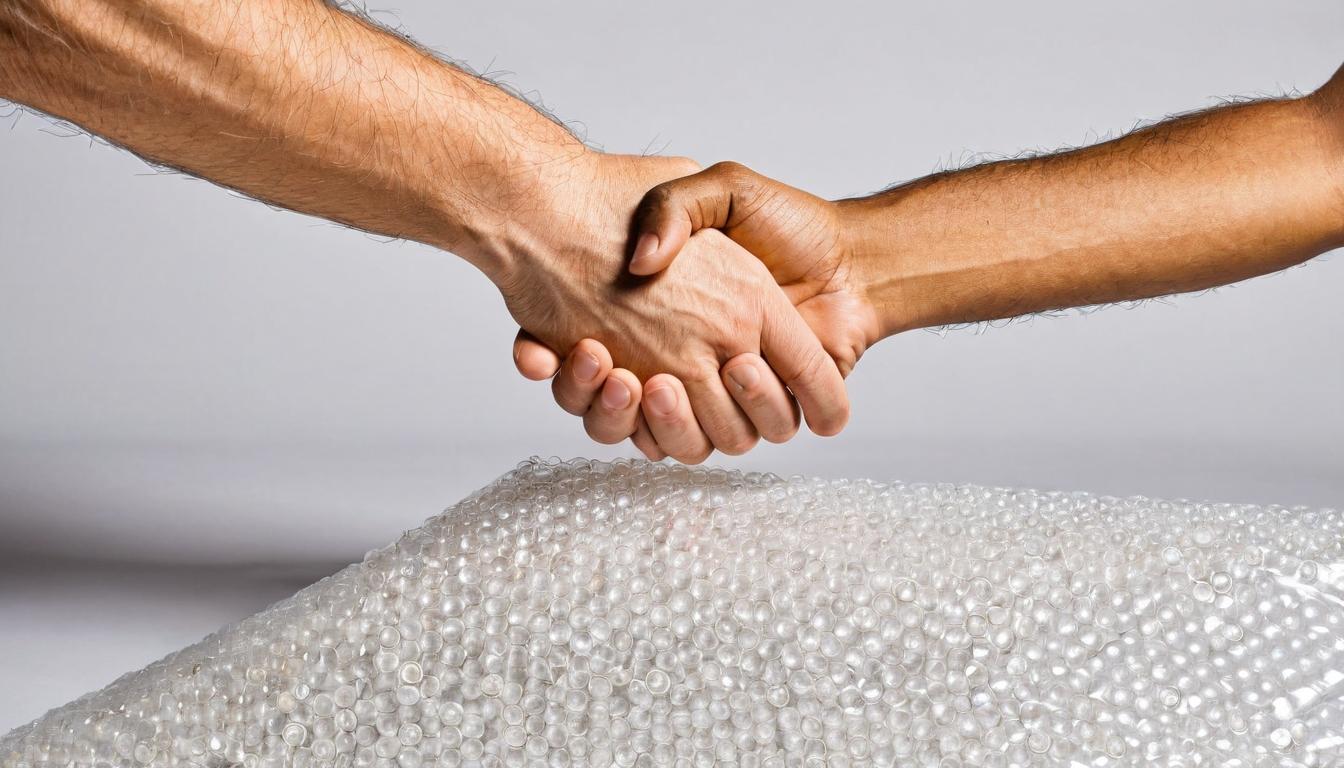
If you've ever wondered why we shake hands, you're not alone. This seemingly simple gesture has roots that stretch back to ancient Mesopotamia, where grasping another's right hand demonstrated you weren't holding a weapon. It was a literal disarmament protocol that evolved into a global symbol of peace and agreement. The Romans refined it further, adding the forearm clasp to check for concealed daggers up sleeves. Today, we perform this ritual millions of times without a second thought, carrying forward a security check that's over 4,000 years old.
Consider the humble pencil. That yellow No. 2 you used in school contains a secret ingredient: squid ink. During World War II, pencil manufacturers faced a graphite shortage. An enterprising chemist discovered that mixing powdered graphite with squid ink created a smooth, durable lead that wrote clearly and erased cleanly. The recipe proved so effective that it's still used today, though modern manufacturers keep the exact proportions as closely guarded as Coca-Cola's formula.
Speaking of wartime innovations, bubble wrap wasn't originally designed for packaging. Engineers Alfred Fielding and Marc Chavannes created it in 1957 as textured wallpaper. When that market flopped, they pitched it as greenhouse insulation. That too failed. Then IBM used it to protect their new 1401 computer during shipping in 1960, and suddenly everyone wanted to pop those satisfying bubbles. The material's true purpose emerged entirely by accident, proving that sometimes the best solutions come from unexpected places.
History is full of such accidental discoveries. The microwave oven emerged when engineer Percy Spencer noticed a candy bar melting in his pocket near radar equipment in 1945. Play-Doh began as a wallpaper cleaner in the 1930s before a teacher realized its potential as modeling clay. Even the Slinky was born when naval engineer Richard James watched a torsion spring fall off a shelf and 'walk' down in a captivating motion.
Some everyday objects hide darker histories. The cheerful pink color of Pepto-Bismol originally came from bismuth subsalicylate's reaction with stomach acid—it turns black when exposed to sulfur compounds in the digestive system. Early users were often alarmed when their stool darkened dramatically, though the effect is harmless. Similarly, Listerine was marketed as a surgical antiseptic, floor cleaner, and gonorrhea treatment before finding its niche as mouthwash in the 1920s.
Nature provides its own fascinating oddities. The average cloud weighs about 1.1 million pounds, yet floats because its water droplets are dispersed across such vast volumes. A single bolt of lightning contains enough energy to toast 100,000 slices of bread. And that fresh rain smell? It's called petrichor, caused by oils released from plants mixing with geosmin from soil bacteria—a scent humans can detect at just 5 parts per trillion.
Our bodies harbor equally remarkable facts. Humans share 50% of their DNA with bananas, 60% with fruit flies, and 98.7% with chimpanzees. Your stomach lining completely regenerates every three to four days to prevent digesting itself with hydrochloric acid. And while fingerprints get all the attention, your tongue print is equally unique—no two people have identical tongue contours or patterns of taste buds.
Language itself contains buried stories. 'Salary' comes from 'salarium,' the Roman soldier's salt allowance—hence 'worth his salt.' 'Nightmare' originally referred to a 'mare' or evil spirit that sat on sleepers' chests, not a bad dream about horses. And 'quarantine' derives from the Italian 'quaranta giorni,' the 40-day isolation period for ships during the Black Death.
Even space holds everyday connections. The gold in Olympic medals likely came from neutron star collisions billions of years ago. The helium in party balloons is a finite resource formed during the Big Bang and radioactive decay in Earth's crust. And astronauts' height increases by up to 2 inches in space as spinal discs expand without gravity's compression—though they shrink back upon return.
These hidden narratives remind us that nothing is as simple as it appears. From handshakes to pencils, every object and custom carries layers of history, accident, and adaptation. They're silent witnesses to human ingenuity, showing how necessity, curiosity, and sheer luck have shaped our world in ways we rarely pause to appreciate.
The hidden stories behind everyday objects and historical oddities