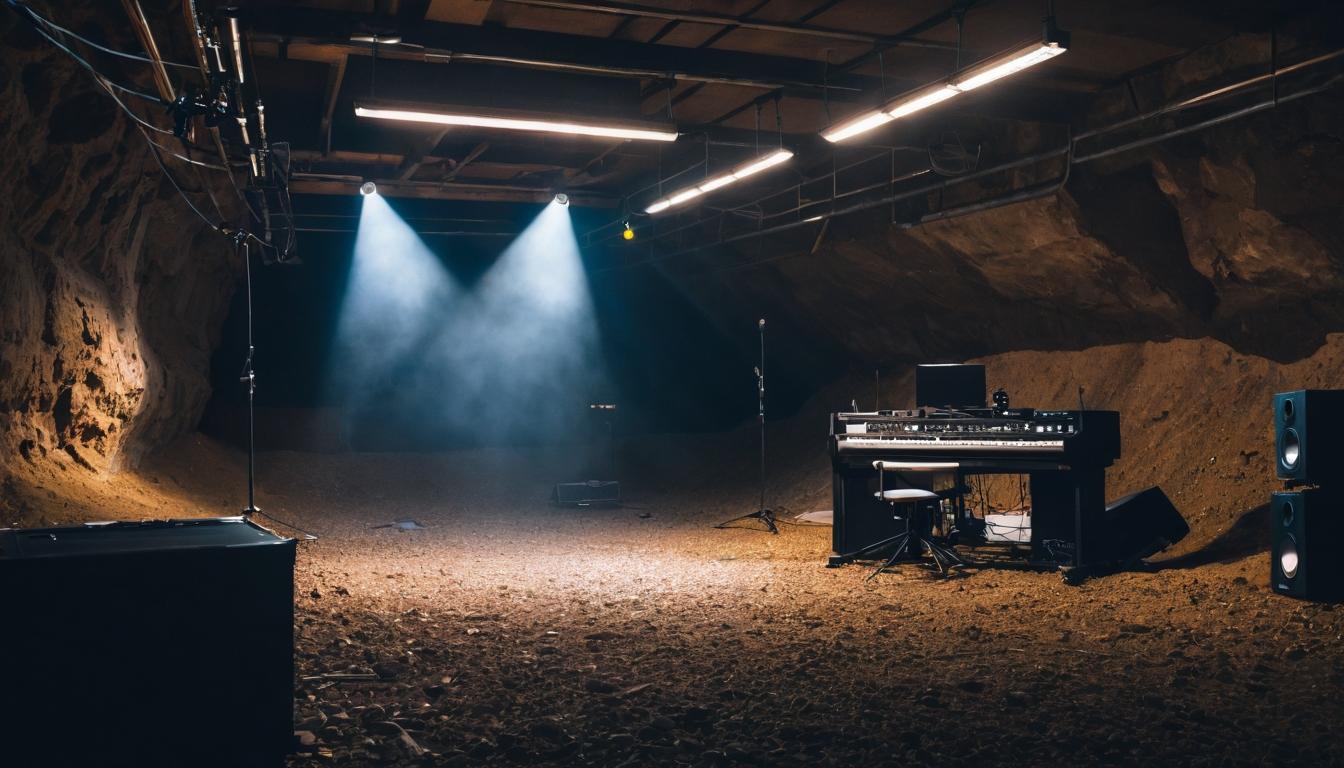
While mainstream charts recycle familiar formulas, a tectonic shift is happening in music's subterranean layers. The very definition of "underground" is being rewritten not by record store crate-diggers, but by algorithmically-curated playlists and Discord servers where genres mutate faster than anyone can name them. This isn't about discovering the next big thing before it hits Spotify's Today's Top Hits—it's about watching entire musical ecosystems emerge, flourish, and sometimes implode before traditional media even notices they exist.
Take hyperpop, that explosive movement that promised to shatter pop conventions with its glitched-out maximalism. Just two years ago, it felt like the future. Now, as Pitchfork recently noted in a sobering analysis, the scene has fragmented into a hundred micro-genres, its pioneers either moving toward more traditional pop structures or disappearing entirely. The collapse reveals a brutal truth about internet-born music: velocity kills. When trends accelerate at TikTok speed, scenes burn bright and fast, leaving behind cultural ash rather than lasting foundations.
Yet from that ash, something more interesting is growing. Over at Stereogum, writers have been tracking the rise of "sludge pop"—a deliberately slow, textural approach that feels like a direct rebellion against hyperpop's frantic energy. Artists like Ethel Cain and They Are Gutting a Body of Water aren't just making slow music; they're constructing immersive worlds where tempo becomes architecture. This isn't nostalgia for shoegaze's heyday, but rather a conscious slowing-down, a refusal to keep pace with the algorithm's demand for constant novelty.
Meanwhile, the tools of creation are undergoing their own quiet revolution. As Hypebot's industry reports detail, AI music tools are moving beyond gimmicky Beatles "reunions" and into the hands of bedroom producers creating genuinely novel soundscapes. The most interesting development isn't AI generating complete songs, but rather artists using tools like Stable Audio to create impossible instruments—synthesizers that sound like decaying tape loops, drum machines that mimic organic respiration. The rebellion here is technological, with artists weaponizing the very tools that threaten to automate them.
This technological anxiety manifests differently in hip-hop's avant-garde. The Fader's coverage of artists like MIKE and Navy Blue reveals a scene turning inward, trading trap's bombast for whispered confessionals over samples that sound like memories half-remembered. The production is deliberately lo-fi, not as an aesthetic choice but as an ethical one—a rejection of streaming's demand for crystal-clear, algorithm-friendly mixes. These artists aren't just making music; they're creating safe spaces in sound, digital environments where vulnerability isn't a liability.
Across the Atlantic, NME has documented Britain's own underground renaissance, where drill's aggression is mutating into something stranger. Artists like Knucks and ENNY are blending the genre's rhythmic complexity with jazz samples and storytelling that feels more like short films than braggadocio. The innovation here is narrative—using drill's framework to tell nuanced stories about community, gentrification, and survival that mainstream UK rap often glosses over.
Perhaps most surprisingly, the metal underground is experiencing its most radical transformation in decades. As Consequence's deep dives reveal, bands like Chat Pile and Soul Glo are dismantling genre boundaries entirely, creating politically charged music that's as likely to reference noise rock as it is hip-hop. The mosh pit has become a political space, the breakdown a moment of collective catharsis about climate anxiety and systemic collapse. This isn't escapism—it's confrontation set to drop-tuned guitars.
What connects these disparate movements is their relationship to failure. In an industry obsessed with virality and metrics, these artists are embracing obscurity, difficulty, and deliberate un-commerciality as creative virtues. They're building scenes not in physical venues (though those matter), but in digital spaces where the rules are still being written. The most exciting music today isn't trying to win—it's trying to survive, to create meaning in an attention economy designed to strip it away.
This underground isn't a monolith but an archipelago of interconnected scenes, each with its own values, aesthetics, and survival strategies. They share only a common enemy: the homogenizing pressure of streaming economics and the content machine's hunger for endless novelty. Their resistance takes different forms—slowing down, turning inward, embracing technology, telling harder truths—but the impulse is the same: to make music that means something beyond its playlist placement.
The real story isn't in any single genre or artist, but in this collective reimagining of what music can be when it stops trying to be everything to everyone. As these scenes evolve, they're not just producing new sounds, but new ways of being an artist in the digital age—less as content creators, more as community builders, technologists, and archivists of feelings that don't fit neatly into mood-based playlists. The future of music isn't a sound; it's a stance.
The underground sounds reshaping pop: from hyperpop's collapse to AI's creative rebellion